
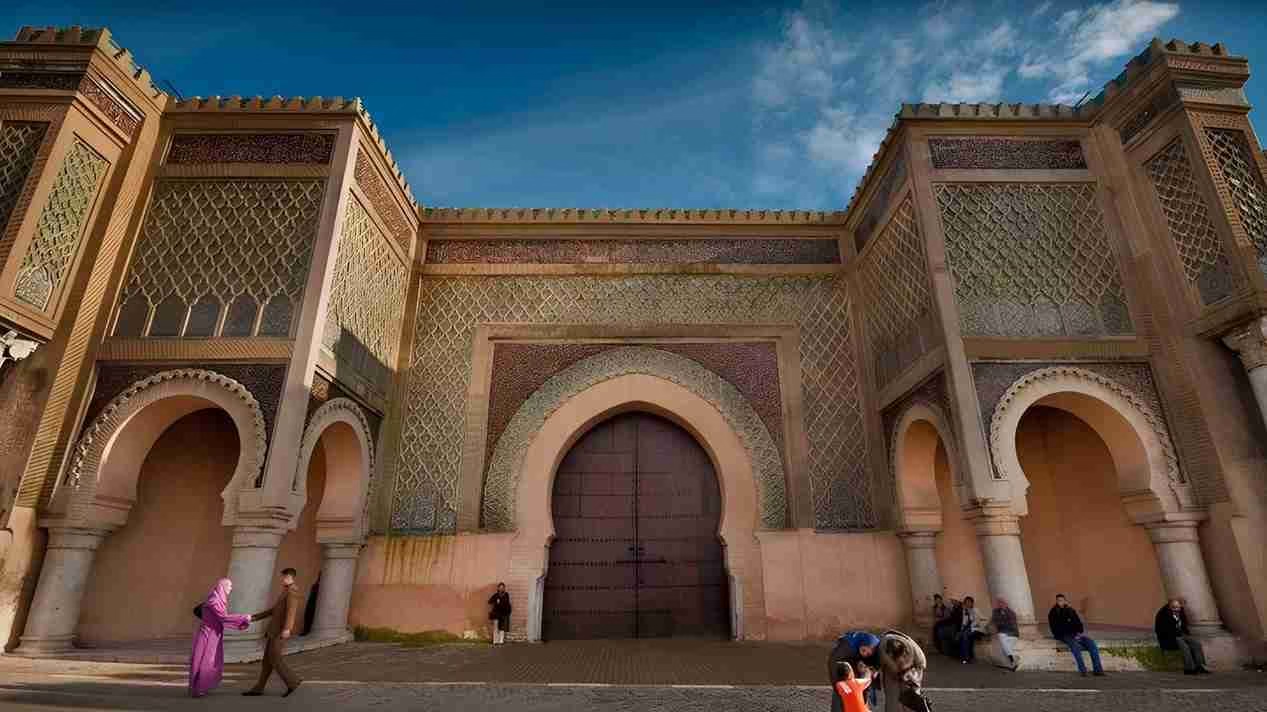
Meknes
One sultan spent fifty-five years trying to out-build Versailles, and most of what still stands in Meknes today is what he left behind. Moulay Ismail moved Morocco’s capital here in 1672, wrapped the city in tens of kilometres of wall, and built stables sized for twelve thousand horses. Fes, an hour down the road, kept the religious schools and the souks. Meknes kept the scale.
The City One Sultan Built To Outshine Versailles
Almoravid forces founded the city as a military outpost on the central plateau in the 11th century, and it stayed a regional town until 1672, when a twenty-six-year-old prince named Moulay Ismail took the throne after his half-brother died in a riding accident. Ismail moved the capital here almost immediately and spent the next fifty-five years, the longest reign in Moroccan history, turning it into the seat of Alaouite power.
What he built is hard to overstate. Contemporary accounts describe more than twenty kilometres of wall around the imperial quarter, pierced by twenty monumental gates and enclosing upward of fifty palaces, granaries and barracks. Tens of thousands of captives and conscripted laborers carried out the work, many of them prisoners taken in coastal raids along the Atlantic. Ismail is often compared to his contemporary Louis XIV, partly for the scale of his ambition, and historical accounts also describe a ruler with little patience for delay or imperfection, a temperament that shaped the city as much as any of his architects did.
None of it outlasted him quite the way he intended. Within a few years of Ismail’s death in 1727, his sons fought over the succession, the Moroccan capital drifted back toward Fes and Marrakech, and a 1755 earthquake, the same one that struck Lisbon, brought down sections of the granaries and stables that were never rebuilt. What survived is still enough to fill a full day: the gates, the mausoleum, and a walled inner city UNESCO recognized in 1996.
Worth knowing: Meknes sits about an hour from Fes, close enough that most travelers see it as a half-day stop bolted onto a Fes-based itinerary rather than an overnight destination of its own.
What To See In Meknes
Six sites built or expanded under Moulay Ismail, most still close enough together to cover in a single day.
Bab Mansour
The grand gate finished by Ismail’s son in 1732, built using marble columns hauled from the Roman ruins at Volubilis. Local legend holds that the gate’s own architect lost his life for admitting it could have been built more beautiful still.
Place el-Hedim
The wide square facing Bab Mansour, cleared from the rubble of houses Ismail tore down to make way for his palace approach. Storytellers, snake charmers and tea stalls still gather here most evenings.
Heri es-Souani & The Agdal Basin
A vaulted granary and stable complex built to feed an army and shelter twelve thousand horses, cooled by channels fed from the reservoir next door. Part of the roof collapsed in the 1755 earthquake and was never rebuilt.
Mausoleum of Moulay Ismail
One of the few religious sites in Morocco that non-Muslim visitors can enter, and the resting place of the sultan who built the rest of the city around it. Several interior columns were taken from the same Roman site as Bab Mansour’s.
Medersa Bou Inania
A 14th-century Quranic school that predates Ismail’s reign by three hundred years, with carved cedar beams and zellige tilework that rivals anything in Fes, just on a smaller, quieter scale.
The Medina & Damascene Workshops
Smaller and less visited than the medinas in Fes or Marrakech, with a long-standing specialty in damascene work, the technique of inlaying fine silver thread into blackened metal.
Tours That Visit Meknes
Itineraries below all include Meknes, whether as a single-day stop or part of a longer route through Morocco.


Planning Your Visit
Best Time To Go
April through June and September through November sit between the plateau’s dry summer heat and its occasional winter cold. Summer afternoons regularly pass 35°C with little shade in the old imperial quarter; winter nights can dip close to freezing.
Getting To Meknes
Most visitors arrive via Fes, about an hour away by ONCF train, grand taxi or road. Direct trains and CTM or Supratours buses also connect Meknes to Casablanca, Rabat and Tangier without needing to change in Fes first.
Getting Around
The imperial city covers far more ground than the medina alone, so a petit taxi between Bab Mansour, the mausoleum and Heri es-Souani saves real time. The medina itself is compact enough to manage on foot.
What To Wear & Bring
Cover shoulders and knees for the mausoleum visit, bring sun protection even outside summer since the imperial quarter offers little shade, and wear shoes that can handle the uneven stone floors inside Heri es-Souani.
Frequently Asked Questions About Meknes
Quick answers to what people ask us most before adding Meknes to their Morocco itinerary.
Is Meknes worth visiting?
Most people choosing between Meknes and Fes aren’t skipping imperial Morocco altogether, and that trade-off is reasonable if time is tight. But the scale of what Moulay Ismail built here, walls running for kilometres and a granary built to feed an army, doesn’t really exist anywhere else in the country.
How far is Meknes from Fes?
About 60 kilometres, roughly an hour by car, train or bus. It’s one of the shortest distances between any two of Morocco’s imperial cities.
Can you visit Meknes as a day trip from Fes?
Comfortably. Bab Mansour, the mausoleum and Heri es-Souani can all be covered in four to five hours, leaving enough daylight to add Volubilis on the way back if you’re driving rather than taking the train.
What is Meknes known for?
Being the capital Sultan Moulay Ismail built almost from nothing in the late 17th century: kilometres of walls, the Bab Mansour gate, and a granary complex designed to feed an army and shelter twelve thousand horses.
Is the Royal Palace in Meknes open to visitors?
No. Dar el-Makhzen remains an active royal residence and stays closed to the public, the same as the working palaces in Rabat and Fes. The mausoleum and Heri es-Souani nearby are open in its place.
How does Meknes compare to Fes or Marrakech?
Fewer crowds and far less souk pressure. Meknes trades the dense, maze-like medinas of Fes and Marrakech for wide imperial-scale monuments spread across more open ground, which keeps it feeling calmer even on a busy afternoon.
Can you visit Volubilis from Meknes?
Easily. The Roman ruins sit about 30 kilometres away, usually paired with a stop in the hilltop pilgrimage town of Moulay Idriss Zerhoun on the same day trip.
What’s the best time of year to visit Meknes?
April through June and September through November avoid both the plateau’s dry summer heat and its occasional winter cold spells. Midday sun still carries weight even in those shoulder months, since the old imperial quarter has little natural shade.
Plan Your Trip To Meknes
Tell us your dates, group size and what you’d like to see, and we’ll suggest a route or work Meknes into a longer Morocco itinerary. Continuing on from here? We also run tours to Fes, Marrakech, Casablanca, Tangier and the Sahara.