
Fes
Five centuries before Oxford existed and two before Bologna, a woman named Fatima al-Fihri spent her entire inheritance building a mosque and school in Fes that never stopped operating. The University of al-Qarawiyyin, founded in 859, is recognized by UNESCO and Guinness World Records as the oldest continuously running place of higher learning anywhere on Earth, and it still teaches students today inside the same medina where it was built. That medina, Fes el-Bali, is also the largest car-free urban area in the world: no engines fit through alleys built for mules eight centuries before anyone needed to fit a car through them.
The City That Never Stopped Teaching
Fes began in 789, when Idris I, founder of Morocco’s first Islamic dynasty, established a settlement on the banks of the Fes River. His son, Idris II, expanded it into a proper capital a few years later, splitting the city into two banks that still shape the medina’s layout today: Andalusian refugees settled one side, refugees from Kairouan in Tunisia settled the other. That second wave brought a family named al-Fihri, whose daughter Fatima would go on to do more for the city’s reputation than any sultan who followed her.
In 859, Fatima al-Fihri spent her entire inheritance building a mosque and school for her community, supervising the construction herself for two years without missing a day of prayer. What grew out of it, the University of al-Qarawiyyin, is recognized by UNESCO and Guinness World Records as the oldest continuously operating institution of higher learning on Earth, predating Bologna by more than two centuries and Oxford by closer to two and a half. Scholars including the cartographer al-Idrisi and the philosopher Ibn Rushd studied or taught there; Pope Sylvester II reportedly visited for the mathematics. Its library, restored and reopened to the public in 2016, still holds a ninth-century Quran written on camel-skin vellum.
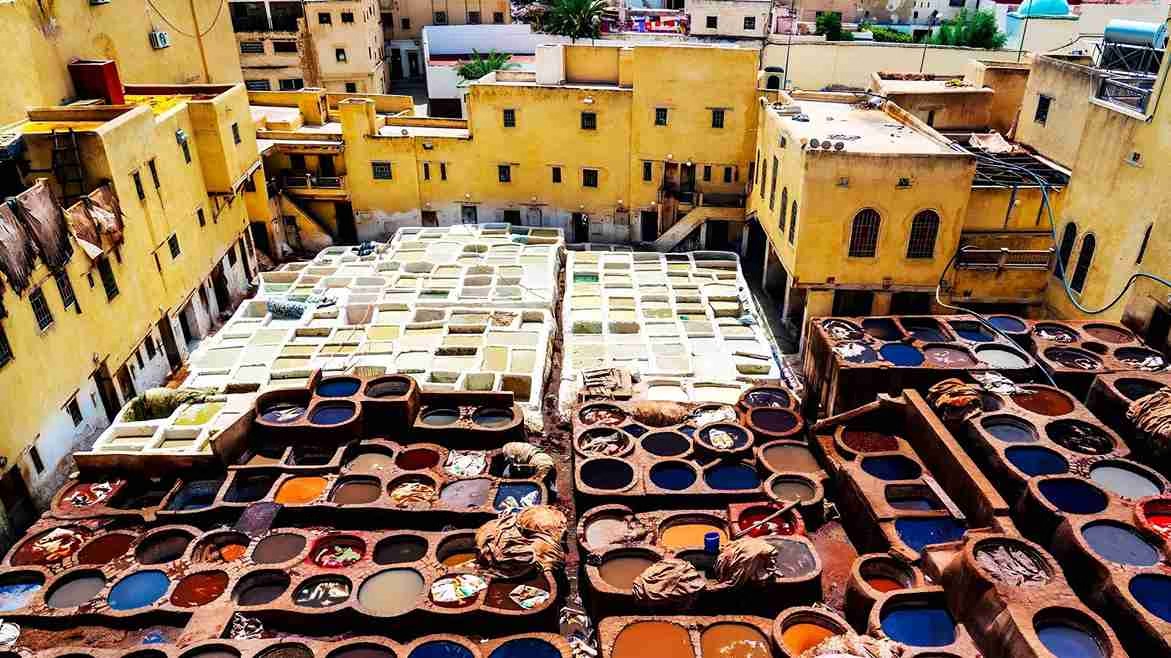
What surrounds that university is, by most counts, the largest car-free urban area anywhere in the world: a medina, Fes el-Bali, threaded with somewhere around nine thousand alleys too narrow for anything wider than a loaded mule. Donkeys and handcarts still do the work delivery vans would do elsewhere, hauling everything from building supplies to fresh leather through passages that haven’t changed shape in centuries. The Chouara Tannery, working since the medieval period using the same pigeon-dropping treatments and natural dyes its name implies, is the most photographed proof of how little some trades here have modernized.
One practical thing: Fes el-Bali has no street signs in any meaningful sense, and even residents get lost in unfamiliar quarters. Hiring an official guide for the first half-day pays for itself in time saved, and most visitors pair Fes with Meknes, about an hour away, on the same trip.
What To See In Fes
Six places that explain why this medina, not any single monument, is the real attraction.
University & Mosque Of Al-Qarawiyyin
The oldest continuously operating place of higher learning on Earth, founded in 859. The mosque itself stays closed to non-Muslims, but the restored library and museum, reopened in 2016, are open to the public.
Chouara Tannery
Stone vats dyeing leather by hand using methods barely changed since medieval times. Surrounding shops offer rooftop terraces to view the vats from above, free if you’re browsing, since the smell makes a closer look an acquired taste.
Bou Inania Madrasa
A 14th-century Quranic school built by the Marinid dynasty, widely considered the most architecturally refined madrasa in Fes. Its carved cedar, zellige tilework and a working water clock across the street are all original to the period.
Bab Boujloud
The medina’s main gate, tiled blue on the side facing the new city and green on the side facing the old one, blue being the colour associated with Fes and green with Islam. Most medina visits begin or end passing through it.
Royal Palace Gates (Fes el-Jdid)
Seven brass doors, each set with hand-hammered geometric panels, marking the entrance to a working royal palace closed to the public. The plaza in front is one of the few open, photogenic spaces in a city built almost entirely without them.
The Mellah & Andalusian Gardens
One of Morocco’s oldest Jewish quarters, distinguished from the rest of the medina by wooden balconies rather than blank walls, a style borrowed from synagogue architecture. The gardens nearby give the only real greenery inside the old walls.
Tours That Visit Fes
Itineraries below all include Fes, whether as a single-day stop or part of a longer route through Morocco.


Planning Your Visit
Best Time To Go
March through May and September through November bring the most comfortable temperatures for walking the medina for hours at a stretch. Summer regularly passes 35°C with little shade between the high walls, and winter brings cold, occasionally rainy days.
Getting To Fes
Fes-Saïss Airport handles a modest number of direct European routes. Most visitors arrive by train from Casablanca, Rabat or Tangier, or by road from Meknes, about an hour away.
Getting Around
Fes el-Bali is closed to almost all vehicles, so everything inside happens on foot, often with a guide for the first visit given how easy it is to lose orientation. Fes el-Jdid and the new city beyond it are reachable by petit taxi.
What To Wear & Bring
Comfortable, closed shoes matter more here than in almost any other Moroccan medina, given the sheer distance covered on uneven stone underfoot. Modest dress is appreciated near the university and madrasas, and small bills help for tips and minor purchases.
Frequently Asked Questions About Fes
What travelers actually search before adding Fes to a Morocco itinerary.
Is Fes worth visiting?
Yes, and for a different reason than Marrakech or Rabat: this is Morocco’s oldest and most intact medieval city, with a university older than any in Europe still teaching inside the same walls it was founded in.
Is Al-Qarawiyyin really the oldest university in the world?
By UNESCO and Guinness World Records’ definition of a continuously operating institution, yes. It was founded in 859, predating the University of Bologna by more than two centuries.
Can tourists visit the University of al-Qarawiyyin?
Not the working mosque itself, which stays closed to non-Muslims, but the restored library and an adjoining museum reopened to the public in 2016 and can be visited on a ticket.
How many days do you need in Fes?
Two full days cover the medina’s main sights at a reasonable pace: the university, the tanneries, a madrasa or two, and Fes el-Jdid. A single rushed day is possible but leaves little room to actually get lost, which is half the experience.
Is it true Fes has no cars in the old city?
Largely, yes. Fes el-Bali is widely considered the largest car-free urban area in the world, with alleys too narrow for vehicles and goods still moved by mule and handcart.
Is Fes a good day trip from Meknes, or the other way around?
Either works, since the two sit about an hour apart. Most multi-day itineraries base in one and visit the other, rather than treating them as a single rushed day.
What does the smell at the Fes tanneries actually come from?
Pigeon droppings and lime, both used in the traditional process to soften hides before dyeing. Mint leaves, handed out at the viewing terraces, are the long-standing local solution.
What’s the best time of year to visit Fes?
March through May and September through November, avoiding both summer heat that regularly passes 35°C and winter’s colder, occasionally rainy days.
Plan Your Trip To Fes
Tell us your dates and how much time you’d like to spend getting lost in the medina, and we’ll suggest a route built around Fes or a longer circuit. Continuing on from here? We also cover Meknes an hour away, Chefchaouen to the north, and Rabat and Marrakech further south.