
Do You Need a Driver in Morocco, or Can You Do It Yourself?
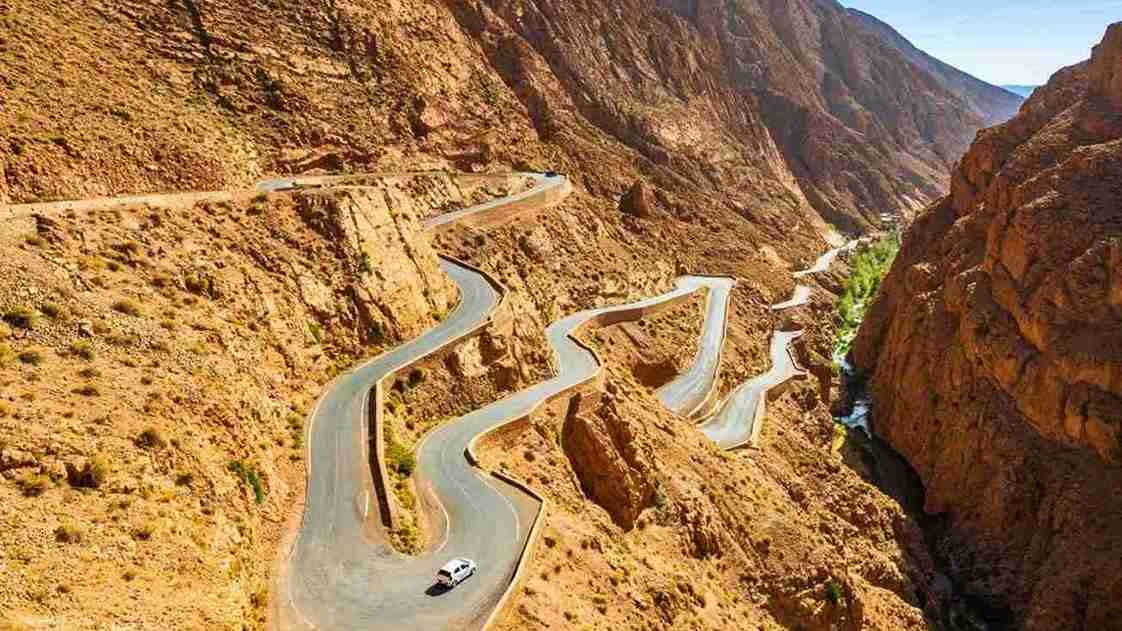
Self-drive works well in northern and coastal Morocco. It works badly on the southern desert routes. If your trip is Casablanca, Rabat, Tangier, Chefchaouen and the Atlantic coast, rent a car. If it involves crossing the High Atlas to Merzouga or the Draa Valley, take a driver.
That is the short version, and most people can stop reading there. What follows is why the line falls in that particular place, because almost every article on this subject is published by a car rental company and tells you the roads are fine.
The roads mostly are fine. The problem is not the tarmac.
Private routes with your own driver
Everything below includes a vehicle, a driver who knows the road, and no navigation on your part.
From Marrakech
- Merzouga Sahara Tour3 days · 2 nights›
- Luxury Desert Trip4 days · 3 nights›
- Sahara & Atlas Mountains6 days · 1 night in the dunes›
Distance Lies. Time Is the Real Number.
This is the mistake almost every visitor makes when planning a Morocco route.
In Spain or France, 400 kilometres is an easy afternoon. In southern Morocco, 250 kilometres can eat five hours. Marrakech to Merzouga looks like a long day on the map. It is not a long day. It is two.
The reason is what sits between the towns: a two-lane road with no overtaking lanes, loaded lorries grinding up gradients at 30 km/h, unmarked speed limits dropping to 40 through every village, and a mountain pass that turns 60 kilometres into ninety minutes of hairpins. Nothing about it is dangerous. All of it is slow.
So when you build your itinerary, plan on Moroccan hours rather than European ones, whoever is driving. Half the self-drive trips that go wrong go wrong because the plan was written from a map.
Where Self-Drive Genuinely Works
We sell private tours, so read this section with appropriate suspicion — but it is true.
The motorway network is excellent. Tangier down to Casablanca, Rabat, and on to Marrakech is modern toll road, well surfaced, clearly signed in Arabic and French, with service areas. Driving it is no harder than driving in Portugal.
The Atlantic coast is easy. Essaouira, Oualidia, El Jadida, Agadir. Straightforward roads, light traffic, simple parking, short distances.
The north is manageable. Chefchaouen, Tetouan and the Rif involve mountain roads, but they are shorter and lower than the Atlas, and you are never far from a town.
If that is your trip, hire a car. You will save money and you will be fine.
Not Sure Which Half of Your Trip Needs a Driver?
Send us your route and we will tell you honestly which legs you can drive yourself and which ones are worth handing over. Plenty of our guests drive the north and take us for the south.
Ask About Your Route →Where It Stops Being Fun
The south is a different country to drive in, and four things change at once.
The passes
Tizi n’Tichka climbs past 2,200 metres between Marrakech and Ouarzazate. It is sealed, it is improved, and it is still several hours of continuous hairpins with sheer drops, no barrier in places, and lorries taking the racing line around blind corners. In winter it can close for snow with no warning. Drivers who do it weekly find it routine. Doing it for the first time, on the wrong side of the car, while navigating, is a long afternoon.
Night driving
This is the single biggest risk and almost nobody warns about it. After dark on rural roads you will meet unlit donkey carts, mopeds with no rear light, pedestrians walking on the tarmac in dark clothing, and livestock. Our own rule is simple: we do not schedule arrivals after dark if we can avoid it. If you are self-driving, adopt the same rule and build your days around it.
Checkpoints and speed traps
Gendarmerie checkpoints sit at the entrance and exit of most towns. They are routine, they are polite, and they are not something to be nervous about — you will usually be waved through. Have your passport, licence and rental documents to hand. Speed limits drop sharply on the approach to villages and are enforced with radar. Fines are issued on the spot.
Distance between everything
Once you are south of the Atlas, fuel stations, mechanics and phone signal all thin out. A breakdown between Boumalne and Erfoud is not a crisis, but it is a long afternoon with limited options, and your rental company’s roadside cover may be several hours away.
The Argument Nobody Makes: Your Car Will Be Parked
Take a typical two-week loop — Casablanca, Fes, Merzouga, the Dades, Marrakech. Now count the days the car actually moves. Three in Fes: parked. Two in Marrakech: parked. The desert night: parked at Merzouga while you are in the dunes. On a fourteen-day trip you might drive on six of them, and pay for the car on all fourteen.
It gets worse in the cities, because you cannot park at your accommodation anyway. Medinas are closed to traffic, so you leave the car in a guarded lot outside the walls and walk or taxi in. Every arrival and departure becomes a small logistics exercise.
A driver is priced for the days you travel. That gap is much narrower than the headline rates suggest, and for groups of four or more it can close entirely.
Four People or More?
A private vehicle is priced per trip, not per person, so the per-head cost drops sharply with a family or a group of friends. Send us your numbers and we will price it properly against what a rental would actually cost you.
Get a Private Price →The Hybrid Almost Nobody Considers
You do not have to choose once for the whole trip.
The pattern that works best, and the one we set up most often, is this: train between the northern cities, driver for the south. Morocco’s rail network links Tangier, Rabat, Casablanca, Fes and Marrakech comfortably and cheaply, and no train goes anywhere near the desert. So take the train where it goes, and pick up a vehicle and driver for the days it does not.
You get the independence where independence is easy, and you hand over the driving exactly where it becomes work.
Book a Driver If Any of These Apply
Straightforwardly: you are crossing the Atlas to the desert. You have fewer than seven days and cannot afford to lose one to a wrong turn. You are travelling with children, or with anyone who gets carsick on switchbacks and would rather be in a larger vehicle. You are four or more people. You are visiting between December and February, when the passes are unpredictable. Or you simply do not want your holiday to involve six hours of concentration a day.
And rent a car if you are two confident drivers, sticking to the north and the coast, with time to spare and a genuine appetite for the road. That is a good trip too, and we will tell you so if you ask us.
If the desert is on your list, our guides to what changes between a €95 and a €470 desert tour and what a night in a Sahara camp is really like cover what happens at the other end of the drive.
Driving in Morocco FAQ
Is it safe to drive in Morocco as a tourist?
Yes, in daylight and on main roads. The risks are night driving on rural roads, mountain passes in winter, and underestimating journey times. Avoid all three and self-drive is reasonable.
Do I need an international driving permit?
Most rental companies accept a home licence for short visits, but requirements vary by nationality and by company. Check with your rental firm before travelling, and carry your passport in the car.
Which side of the road does Morocco drive on?
The right, with signage in Arabic and French using standard European pictograms. Roundabouts are common and priority conventions are not always observed as you might expect.
Can I drive to Merzouga myself?
You can, and people do. It is two days each way from Marrakech if done sensibly, involves the Tizi n’Tichka pass, and ends where the tarmac does — the camps themselves are reached by 4×4 or camel.
Is a private driver expensive in Morocco?
Less than most people assume, because the vehicle is priced for the trip rather than per person. Compared against a rental you pay for on days you do not drive, plus fuel, tolls and parking, the gap narrows considerably.
Do I need a 4×4?
Not for any standard route. Every main road including the desert approach is sealed. A 4×4 only matters if you plan to leave the tarmac, which you should not do alone.
More Stories from MBT
Send Us The Plan And We’ll Tell You What’s Realistic
Give us your cities and dates and we’ll come back with honest driving times, which legs are worth a driver, and where the train does the job better.